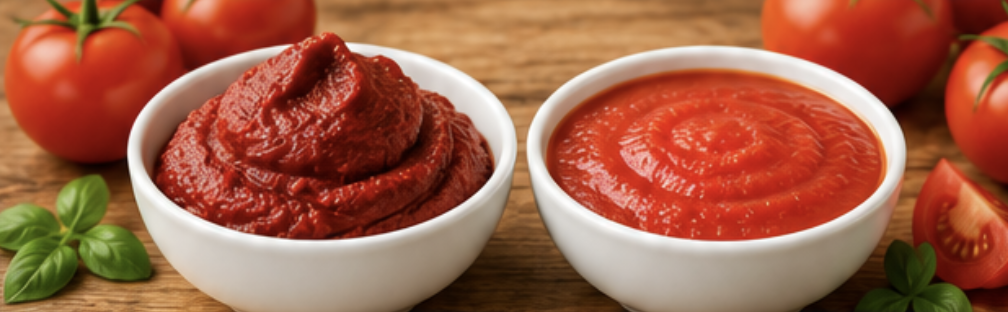
Tomato paste and tomato puree are both widely used in commercial food production, but they are not interchangeable in every recipe. The main difference is concentration, which affects tomato flavor, solids, viscosity, water balance, and the amount required in a formulation.
For food manufacturers, choosing between tomato paste and tomato puree should therefore be based on the finished product and recipe requirements rather than simply the product name.
What Is Tomato Paste?
Tomato paste
Tomato paste is a concentrated tomato product made by removing a substantial amount of water from tomatoes. Under USDA standards, canned tomato paste contains at least 24% natural tomato soluble solids. Higher concentration ranges are also used commercially.
This high concentration gives tomato paste a stronger tomato character and allows manufacturers to add significant tomato solids without adding as much water.
Common applications
Tomato paste is commonly used in:
- Pizza and pasta sauces
- Ketchup
- Soups and stews
- Ready meals
- Marinades and prepared sauces
Because of its concentration, a relatively small quantity can contribute considerable tomato solids to a finished formulation.
What Is Tomato Puree?
Tomato puree has a lower concentration than tomato paste. The USDA standard defines canned tomato puree as containing at least 8% but less than 24% natural tomato soluble solids.
Puree usually provides a more fluid tomato base and can be useful when a recipe requires both tomato flavor and additional moisture.
Its consistency and concentration make it suitable for products such as:
- Tomato sauces
- Soups
- Ready meals
- Cooking sauces
- Other products where a less concentrated tomato base is preferred
The exact specification can vary by market and product, so buyers should always check the supplier's specification sheet before making a formulation decision.
Tomato Paste vs. Tomato Puree: Key Differences
| Factor | Tomato Paste | Tomato Puree |
|---|---|---|
| Concentration | Higher | Lower |
| Natural tomato soluble solids | ≥24% under USDA standard | 8% to <24% under USDA standard |
| Texture | Thick and concentrated | More fluid |
| Tomato intensity | Stronger | Milder |
| Water contribution | Lower | Higher |
| Typical use | Concentrated sauces, ketchup, pizza sauce | Sauces, soups, ready meals |
| Formulation impact | Adds solids with less water | Adds tomato solids and more moisture |
The most important point is that concentration affects formulation. A manufacturer cannot simply replace one product with the same weight of the other and expect identical results.
Can Tomato Paste Replace Tomato Puree?
Yes, but the substitution should be calculated according to tomato solids rather than weight alone.
For example, suppose a formulation needs 2 kg of tomato solids. If the selected tomato paste contains 28% natural tomato soluble solids:
Required paste = 2 ÷ 0.28 = 7.14 kgThe same principle can be applied when replacing puree with paste. The exact calculation should use the actual soluble-solids specification of the products being compared.
USDA technical guidance notes that tomato paste and puree are purchased and evaluated in relation to tomato solids or concentration, making solids content an important commercial consideration.
Important: Solids are not the only factor. Replacing puree with paste may also change viscosity, water balance, color, and processing behavior. A production trial is recommended before changing a commercial formulation.
How the Choice Affects Food Formulation
1. Water Balance
Tomato puree contains more water than concentrated tomato paste. Using paste in place of puree may therefore require additional water or other liquid ingredients to achieve the same final consistency.
2. Texture and Viscosity
Paste can increase thickness quickly, while puree provides a more fluid tomato base. This difference can affect pumping, mixing, filling, and the texture of the finished product.
3. Tomato Flavor
A higher concentration generally allows manufacturers to achieve stronger tomato character with less product. However, the final flavor also depends on tomato variety, processing conditions, formulation, and other ingredients.
4. Processing
For industrial sauces, the choice of concentrate can affect cooking time and the amount of water that needs to be removed during processing. It is therefore useful to evaluate the ingredient together with the actual production process rather than selecting it based only on laboratory specifications.
Which One Should Food Manufacturers Choose?
The right choice depends on the product being manufactured.
Choose tomato paste when
- A concentrated tomato base is required
- The formulation needs more tomato solids with less added water
- Storage or transportation efficiency is important
- The product requires a thicker tomato base
Choose tomato puree when
- A less concentrated tomato ingredient is preferred
- The recipe already requires additional tomato moisture
- A more fluid starting base is easier to process
- The formulation is designed around puree rather than concentrate
For products such as ketchup and concentrated pizza sauce, paste is often more practical. For some soups, sauces, and ready meals, puree may provide easier control of moisture and consistency.
Compare Cost by Usable Tomato Solids
A common purchasing mistake is comparing tomato paste and puree only by price per kilogram.
A cheaper product is not necessarily cheaper in the final formulation because the products contain different amounts of tomato solids.
Cost per kg of tomato solids = Product price per kg ÷ tomato soluble solids fractionFor example, if a tomato paste costs $1.20/kg and contains 28% soluble solids:
$1.20 ÷ 0.28 = $4.29 per kg of soluble solidsThis provides a more meaningful basis for comparing products with different concentrations.
For large-volume purchasing, manufacturers should also consider yield, water adjustment, processing time, packaging, storage, and freight costs.
What Should Buyers Check Before Ordering?
Before purchasing tomato paste or puree for commercial production, check:
- Natural tomato soluble solids or concentration
- Ingredient specification
- Color and flavor requirements
- Texture or consistency
- Acidity and other formulation requirements
- Packaging and storage conditions
- Sample performance in the actual recipe
USDA grade standards evaluate tomato paste and puree using factors such as flavor, color, defects, and other quality characteristics, showing why concentration alone should not be treated as the complete quality assessment.
Conclusion
Tomato paste and tomato puree serve different formulation purposes. Paste provides a more concentrated source of tomato solids, while puree offers a lower-concentration tomato base with more moisture.
For B2B food production, the better choice depends on the required tomato solids, viscosity, water balance, processing method, and final product.
Instead of comparing products only by price per kilogram, manufacturers should compare usable tomato solids, formulation performance, and total production cost. This approach makes it easier to select the right ingredient for sauces, ketchup, pizza products, soups, and ready meals.