Choosing tomato paste for commercial pizza sauce requires more than selecting a concentrated product with a deep red color. Food manufacturers need an ingredient that delivers the right flavor, consistency, and processing performance while maintaining a consistent result across production batches.
The best choice depends on the recipe, production equipment, and finished pizza requirements. By evaluating concentration, viscosity, flavor, and baking performance, manufacturers can identify tomato paste that works reliably in their production process.
1. Define Your Pizza Sauce Requirements
Before selecting tomato paste, determine how the pizza sauce will be produced and used. A sauce made for freshly prepared pizza may have different requirements from one used in frozen pizza manufacturing or large-scale food processing.
Consider the target flavor, desired thickness, application method, and whether the sauce will be cooked before use. These factors help establish practical criteria for evaluating potential ingredients.
It is also important to distinguish tomato paste from finished pizza sauce. Tomato paste is a concentrated ingredient that may need water, seasonings, oil, or other ingredients to achieve the required sauce profile. The final formulation should be developed around the manufacturer's intended product rather than the raw ingredient alone.
2. Compare Tomato Paste Concentration and Yield
Check Soluble Solids Content
Soluble solids content helps buyers compare the concentration of different tomato paste products. A product specification should identify the relevant solids content and measurement basis.
The Codex Standard CXS 57-1981 provides an international reference for product definitions, quality factors, and analytical methods.
Higher concentration can reduce the amount of paste needed to achieve a target solids level, but it does not automatically mean better pizza sauce. Flavor, texture, and processing performance must also meet the recipe requirements.
Adjust the Formulation
When comparing products, consider how much paste is needed to reach the same target solids level. For an initial estimate, the following calculation can help:
Required paste quantity = Target soluble solids ÷ Paste soluble solids fraction
For example, if a recipe requires 2 kg of soluble solids and the paste contains 28% soluble solids, the theoretical paste quantity is approximately 7.14 kg. This calculation assumes the stated solids values are comparable and excludes other ingredients and processing losses.
Use this estimate as a starting point, then confirm the formulation through a production trial.
3. Evaluate Viscosity and Baking Performance
Check Mixing and Spreading
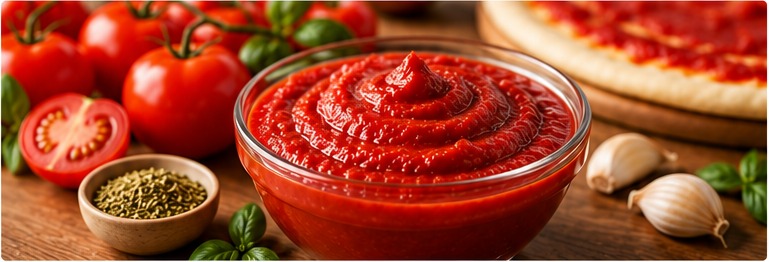
Commercial pizza sauce must be easy to mix, transfer, and spread evenly over the dough. If the paste is too thick for the equipment, additional formulation adjustments may be needed. If the finished sauce is too thin, it may spread unevenly or contribute excess moisture.
Viscosity is not determined by concentration alone. Processing conditions, tomato solids, particle characteristics, and the other ingredients in the sauce can also affect texture.
The USDA's Canned Tomato Paste Grades and Standards provides reference criteria for tomato paste quality and links to technical resources for assessing product consistency.
Observe the Sauce After Baking
A sauce that looks suitable before baking may behave differently in the oven. Excess moisture can contribute to a wet pizza surface or a soft center, although cheese, toppings, dough formulation, and baking conditions also influence the result.
Test the sauce on the intended pizza base and evaluate its appearance after baking. Check for visible water separation, uneven coverage, and changes in texture. This practical assessment is more useful than selecting a paste based on thickness alone.
4. Assess Color, Acidity, and Tomato Flavor
Evaluate the Finished Recipe
A deep red raw paste does not guarantee that the finished pizza sauce will have the desired color. Seasonings, cooking, dilution, and other ingredients can change the final appearance.
Flavor matters just as much. The sauce should provide the intended tomato character without excessive sourness, bitterness, or an unwanted cooked flavor. Whether a sharper or sweeter profile is preferred depends on the recipe and target market.
The U.S. regulation 21 CFR §155.191 provides a regulatory reference for tomato concentrates. Buyers should check the applicable requirements for their product and destination market rather than treating one standard as universal.
Maintain Batch Consistency
For commercial production, consistent results are often more valuable than a sample that performs exceptionally well once. Establish a reference recipe and compare batches under the same preparation conditions.
Record color, aroma, flavor, and texture. If the sauce is produced at scale, documented specifications and repeatable testing help identify differences before they affect a large production run.
5. Match Tomato Paste to Your Production Process
Different production methods place different demands on tomato paste.
| Production application | What to evaluate | Main objective |
|---|---|---|
| Freshly prepared pizza sauce | Mixing, spreading, flavor | Easy application and balanced taste |
| Heat-processed sauce | Texture and flavor after heating | Stable results during processing |
| Frozen pizza | Sauce performance through freezing, storage, and baking | Suitable finished-product quality |
| High-volume production | Batch consistency and equipment compatibility | Repeatable manufacturing results |
For heat-processed products, evaluate the sauce after the actual heating process. For frozen pizza, test the full production cycle, including freezing, storage, and final baking. Do not assume that a paste suitable for one application will automatically perform equally well in another.
Food safety and process control also matter. The Codex Codes of Practice provides broader guidance on hygienic food handling and production practices. Commercial manufacturers should follow the food safety procedures and regulatory requirements applicable to their operations.
6. Conduct a Small-Scale Production Trial
Before approving tomato paste for large-scale production, compare samples using a controlled test.
First, prepare the same base recipe with each candidate product. Keep the dough, sauce application rate, cheese, toppings, and baking conditions consistent. Change only the ingredient being evaluated wherever possible.
Next, record the paste concentration, amount used, any water or seasoning adjustments, and the finished sauce's texture, color, and flavor. After baking, assess coverage, visible moisture, and overall product quality.
Finally, repeat the test if necessary to check whether the result is reproducible. Keep the approved specification and formulation as a reference for future purchases.
This approach helps manufacturers make decisions based on actual production results rather than product descriptions alone.
Frequently Asked Questions
What concentration of tomato paste is best for commercial pizza sauce?
There is no single concentration that suits every recipe. The right choice depends on the target solids level, formulation, equipment, and desired sauce texture.
Does thicker tomato paste always make better pizza sauce?
No. Thick paste may require more adjustment during mixing, while the finished sauce must still spread evenly and perform well during baking.
Should tomato paste be diluted before use?
That depends on the product specification and recipe. Determine the required amount through formulation calculations and small-scale testing.
Conclusion
Choosing tomato paste for commercial pizza sauce requires evaluating concentration, texture, flavor, and performance under real production conditions. A controlled recipe trial helps manufacturers identify the most suitable ingredient and maintain consistent results. Food Junc can provide product information for buyers to assess against their specific pizza sauce requirements.
References
1.Codex Alimentarius Commission. Standard for Processed Tomato Concentrates (CXS 57-1981).
2.United States Department of Agriculture, Agricultural Marketing Service. Canned Tomato Paste Grades and Standards.
3.U.S. Food and Drug Administration. 21 CFR §155.191 — Tomato Concentrates.
4.United States Department of Agriculture, Agricultural Marketing Service. Technical Resources for Tomato Product Consistency and Soluble Solids Determination.
5.Codex Alimentarius Commission. General Principles of Food Hygiene.